Loading…
Mobile2024
Addis Tab
A credit-tab manager for neighborhood businesses — merchants record what customers owe and pay, and customers see their own balance in real time, replacing the paper ledger behind the counter.
Live on the App Store & Google Play
ExpoReact NativeTypeScriptExpo RouterAWS Amplify Gen 2AWS AppSync (GraphQL)Amazon CognitoAmazon S3AWS LambdaTwilioTanStack QueryZustandReact Native SkiaD3React Native PaperSentryEAS Build
Overview
Addis Tab is an iOS and Android app for small businesses — like the neighborhood market it was first built for — that let regular customers buy on credit and settle up later. It replaces the handwritten ledger with a shared, always-current record.
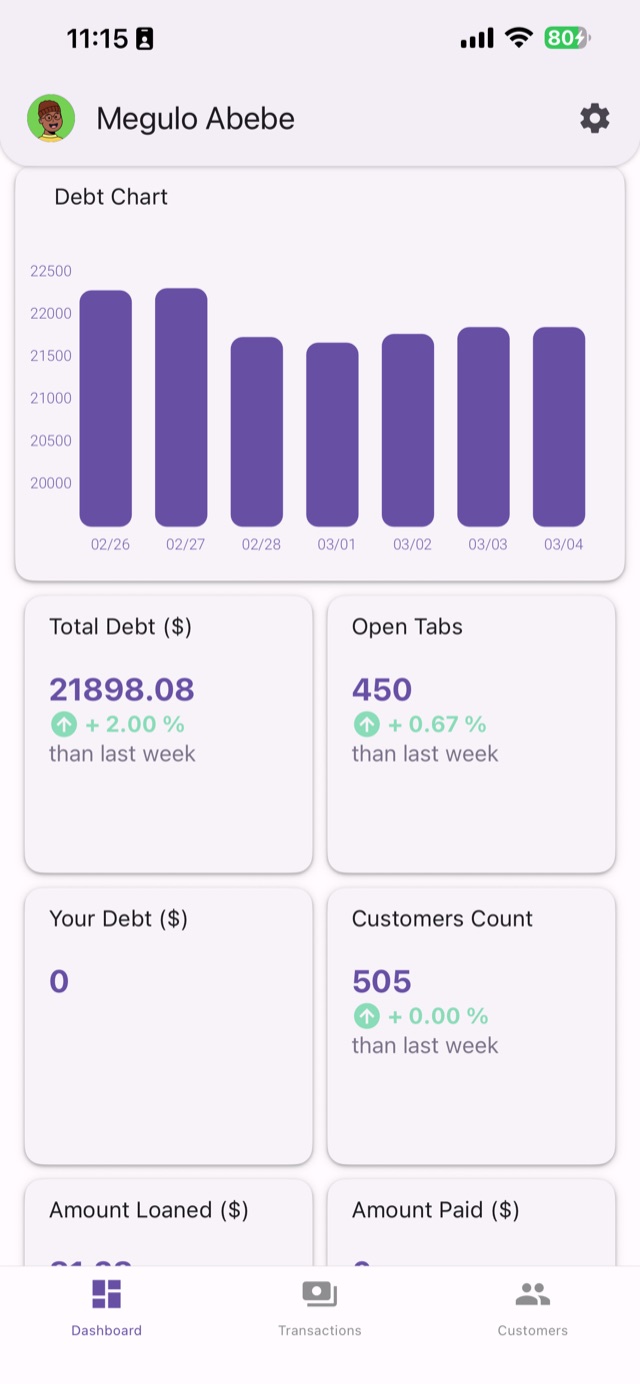
Business owners get a dashboard of total debt, open tabs, customer count, amount loaned and amount paid, with a daily debt chart. They can add customers and record credit or payment transactions, optionally attaching a photo of the receipt. Customers sign in to a read-only view of their own balance and history and get a push notification whenever a new transaction is recorded on their tab.
- Client
- Addis Market
- Our Role
- Design & Development
- Platforms
- Mobile
- Year
- 2024
Key Features
- 01Separate Business and Customer experiences
- 02Live dashboard: total debt, open tabs, collections
- 03Credit & payment entries with receipt photos
- 04Push alerts to customers on every transaction
- 05Passwordless SMS sign-in plus biometric unlock
- 06Offline-first with conflict-safe sync
Challenge
Informal store credit runs on trust and paper. Ledgers get lost, totals drift, and customers have no way to check what they owe — which leads to disputes. The app had to be fast enough to use at a busy counter, simple for customers of any age, keep merchant and customer views in sync across devices, and handle edits made on two phones at once without losing data.
Solution
I built a single Expo / React Native codebase with role-based route groups: Business users land on a dashboard, transactions and customers tabs; Customer users get a personal balance view. Authentication is passwordless — Amazon Cognito custom auth triggers send one-time codes over SMS via Twilio — with biometric unlock for quick daily use. Data lives in AWS AppSync (GraphQL) with optimistic-concurrency conflict resolution, receipt photos go to S3, and Lambda functions handle auth and notifications. Charts are drawn with React Native Skia and D3 for smooth native rendering. TanStack Query with persisted cache makes the app work offline-first, and the backend was migrated from Amplify Gen 1 to the TypeScript-defined Amplify Gen 2.
Results
Addis Tab is published on the App Store and Google Play and is used daily to manage hundreds of customer tabs. Merchants see total exposure and collections at a glance instead of adding up pages by hand, customers can check their balance any time, and every credit and payment has a timestamped record — with a receipt photo when needed — which has cut down on reconciliation errors and disputes.